
Parking Lot Slope Design Principles
Proper drainage is the single most important factor in parking lot longevity. Water is asphalt's greatest enemy — it weakens the base, accelerates oxidation, causes freeze-thaw damage, and creates safety hazards. Every square foot of your parking lot should drain positively to an inlet, edge, or drainage feature. Our commercial parking lot calculator can help you plan the overall project scope alongside drainage design.
The fundamental principle: water should never stand on asphalt for more than 30 minutes after rain stops. This is called the "30-minute rule" and is achieved through proper grading. Here are the recommended slopes for different areas:
| Area | Min. Slope | Target Slope | Max. Slope |
|---|---|---|---|
| Parking stalls | 1.0% | 1.5–2.0% | 5.0% |
| Drive aisles | 1.0% | 1.5–2.0% | 5.0% |
| ADA accessible zones | — | 1.5–2.0% | 2.0% |
| Pedestrian walkways | 0.5% | 1.0–2.0% | 5.0% (running) |
| Near buildings | 2.0% | 2.0–3.0% | 5.0% |
Catch Basin Design and Placement
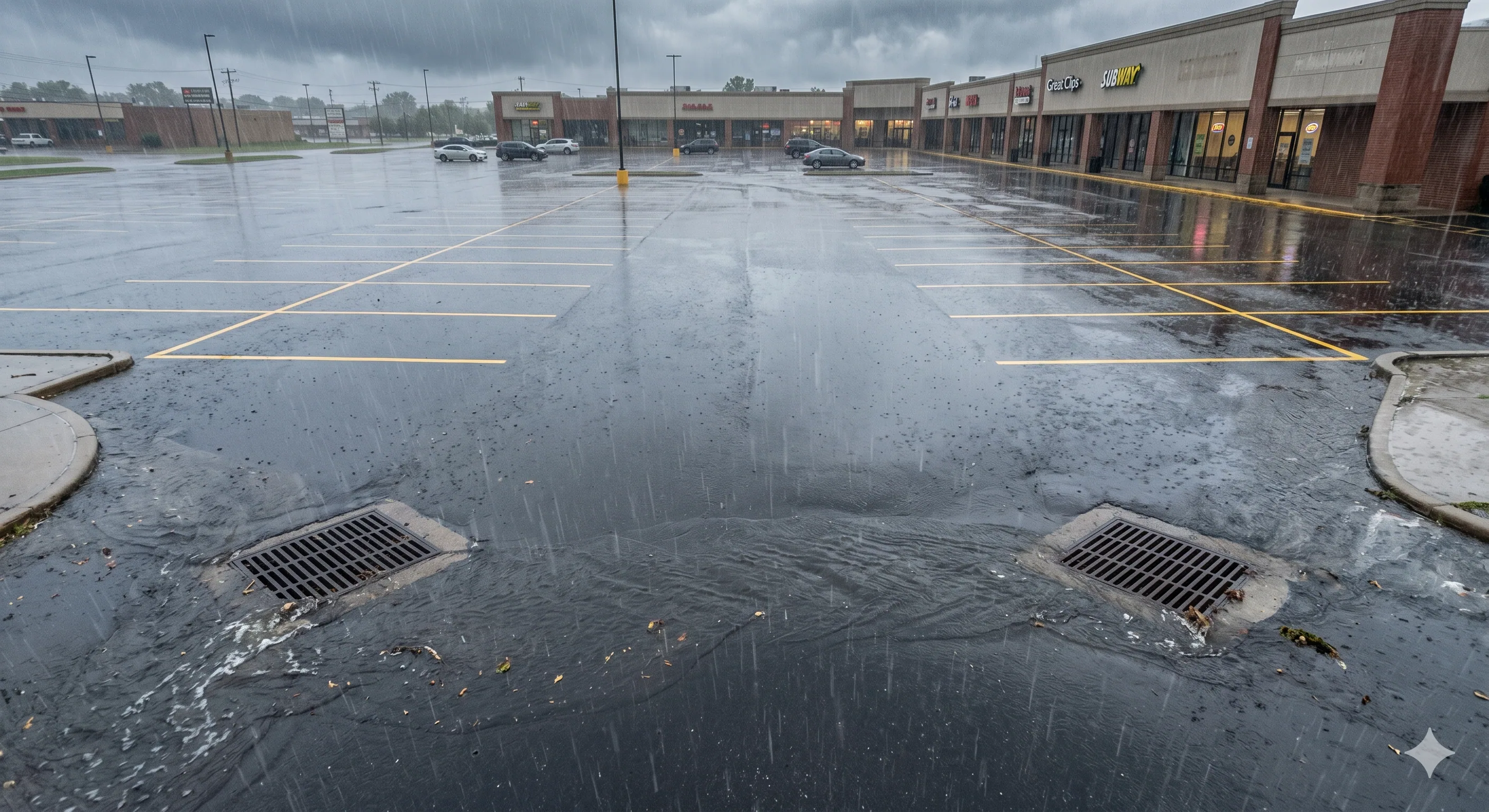
Catch basins (also called storm drains or inlets) collect surface water and channel it into an underground pipe system. Their placement determines how effectively your lot drains and how much standing water accumulates during storms.
Types of Catch Basins
- Grated inlet — Metal grate flush with the pavement surface. Best for drive aisles and general parking areas. Can handle high flow rates but may be clogged by debris.
- Curb inlet — Opening in the face of a curb. Excellent for collecting sheet flow along curb lines. Less prone to clogging than grates. Often used at low points of curbed parking areas.
- Combination inlet — Both grate and curb opening. Provides redundancy — if the grate clogs, the curb inlet still functions. Recommended for critical drainage points.
- Trench drain — Long, narrow channel with a continuous grate. Used at building entrances, loading docks, and where sheet flow must be intercepted across a wide front.
Placement Guidelines
- Place at the lowest point of every drainage area
- Maximum drainage area per inlet: 5,000–10,000 sq ft (less in flat lots)
- In drive aisles, not in parking stalls (to avoid blockage by parked cars)
- 3 feet minimum from building foundations or retaining walls
- Grates must be ADA-compliant (elongated openings perpendicular to traffic flow, max 1/2 inch wide)
Dumpster pad areas require dedicated drainage to handle wash-down water and prevent contamination of the main lot drainage system — see our dumpster pad calculator for pad slope and containment specifications.
Storm Water Management Requirements
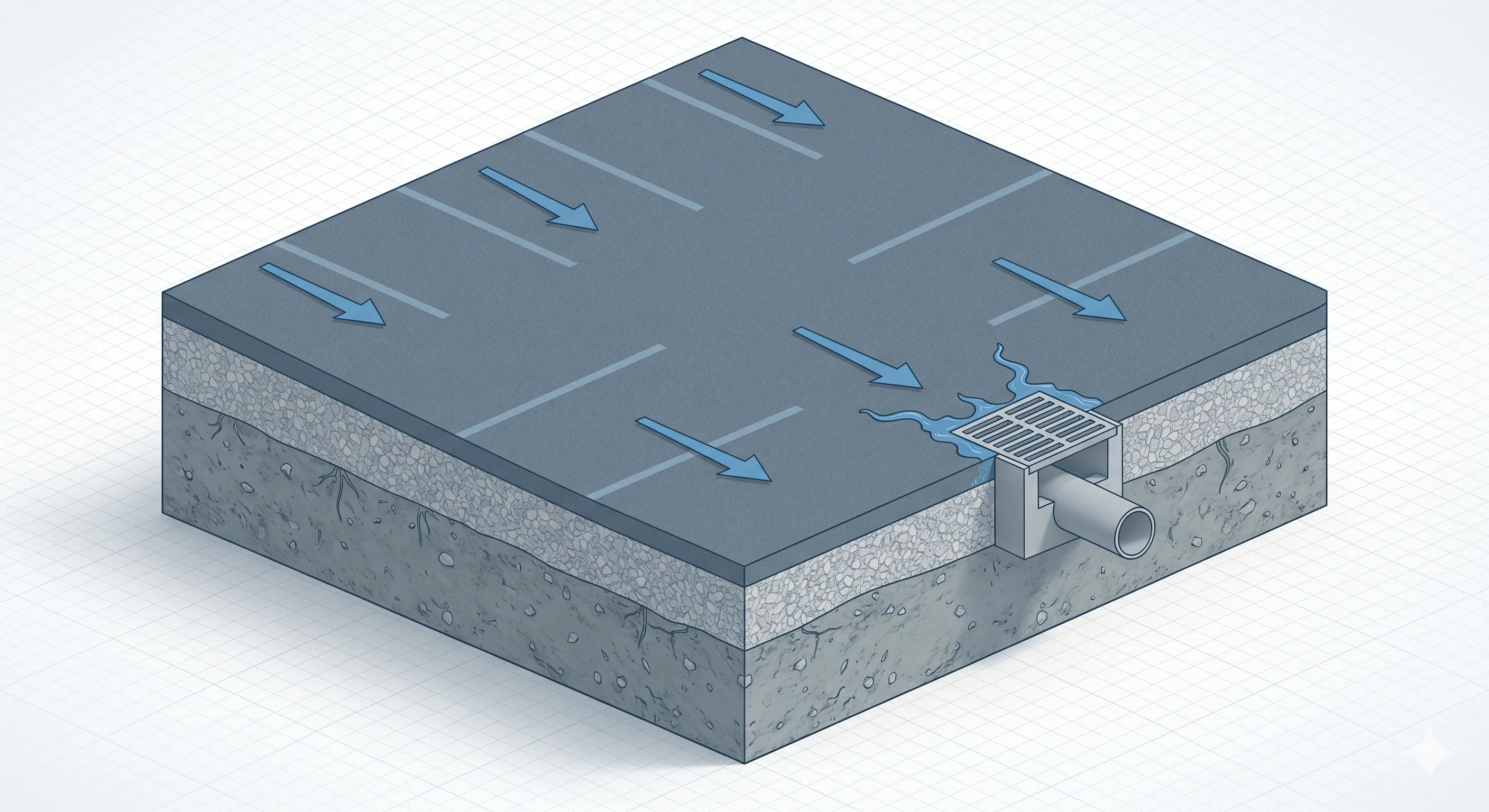
Nearly every municipality requires commercial developments to manage storm water runoff — you cannot simply direct all water to the public storm sewer or neighboring property. The two main regulatory frameworks:
Quantity Control (Detention)
The post-development peak runoff rate must not exceed the pre-development rate. Since a parking lot is impervious (compared to the field or forest it replaced), much more water runs off faster. Detention facilities hold back the difference and release it slowly. Sizing depends on the design storm (typically a 10-year or 25-year, 24-hour rainfall event) and the lot area.
Quality Control (Treatment)
Parking lot runoff contains oil, heavy metals, tire particles, and sediment. Many jurisdictions now require treatment of the first 1 inch of runoff (called the "first flush" or "water quality volume") before it enters the storm system. Treatment options include oil-water separators, bioretention cells (rain gardens), sand filters, and proprietary manufactured treatment devices.
| BMP Type | Pollutant Removal | Space Needed | Cost |
|---|---|---|---|
| Detention pond (dry) | Moderate (sediment) | Large | $3–$8/sq ft of lot |
| Retention pond (wet) | High | Very large | $5–$12/sq ft of lot |
| Bioretention / rain garden | High | 5–10% of lot area | $8–$20/sq ft of BMP |
| Underground detention | Low (quantity only) | None (underground) | $10–$30/sq ft of lot |
| Porous asphalt | High | None (integrated) | 20–30% premium |
Permeable Pavement Options
Permeable (porous) pavement is an increasingly popular solution that combines the parking surface with the storm water management system. There are three main types:
Porous Asphalt
Open-graded hot mix asphalt with 15–20% air voids that allow water to pass through. The asphalt sits on a stone reservoir base (18–36 inches of clean, uniform stone) that temporarily stores water and allows it to infiltrate into the subgrade or be collected by an underdrain. Porous asphalt looks and drives identically to conventional asphalt but requires regular vacuum sweeping. For subgrade evaluation and conventional pavement structure design, see our heavy-duty base design guide.
Pervious Concrete
Similar concept using portland cement concrete without fine aggregate. More expensive than porous asphalt but may be preferred in concrete-dominant southern markets. Requires the same stone reservoir base.
Permeable Interlocking Pavers
Concrete unit pavers with wider joints (1/4–1/2 inch) filled with small aggregate. Water infiltrates through the joints. Highest initial cost but most aesthetically versatile and easiest to repair. Best for lower-speed areas like parking stalls rather than drive lanes.
Maintenance for Drainage Systems
Drainage infrastructure requires regular maintenance to function properly:
| Component | Maintenance Task | Frequency |
|---|---|---|
| Catch basin grates | Remove debris and sediment | Monthly + after major storms |
| Catch basin sumps | Vacuum sediment (should be <50% full) | Annually |
| Detention pond | Mow, inspect outlet, remove sediment | Semi-annually |
| Porous pavement | Regenerative-air vacuum sweeping | Quarterly |
| Oil-water separator | Pump and clean | Semi-annually |
| Trench drains | Remove grates, flush channel | Monthly |
🌧️ Pro Tip: Walk the parking lot during a heavy rainstorm (from a covered vantage point). This reveals exactly where water ponds, which inlets are overwhelmed, and where flow paths have shifted due to pavement settling — information you can't see on a dry day.